
EU Strategies for Sustainable Development
EUROPEAN UNION STRATEGIES FOR SUSTAINABLE DEVELOPMENT
The European Union has played a decisive role in the realisation of sustainable development, starting with the First EU Sustainable Development Strategy adopted by the European Council in Gothenburg in 2001, reviewed in the years to come, and ending with the development of new guidelines in 2009.
In 2015, the EU aligned its policies with the UN Sustainable Development Goals (SDGs), strengthening the link between economic growth and environmental sustainability.
The Union has thus made a decisive contribution to the definition of the 2030 Agenda, and has committed itself, together with the Member States, to also guide its implementation, through the integration of sustainable development goals into EU policies.
In November 2016, the European Commission, with Communication COM (2016) 739 “Next steps for a sustainable European future”, outlined its strategic approach for the implementation of the 2030 Agenda, outlining strategic priorities and emphasising that all the Agenda's sustainable development goals were already reflected in EU policies.
Following up on this Communication, in January 2019 the EC presented a major new Discussion Paper on the 2030 Agenda entitled “Towards a sustainable Europe by 2030”, with which it confirmed the EU's commitment to the Sustainable Development Goals, also in relation to the Paris Agreement on Climate Change, and prepared the ground for a comprehensive EU strategy for the years 2019-2024.
With the start of the Commission chaired by Ursula von der Leyen, the 2030 Agenda has become central to the political action of the European Union, which has focused on wide-ranging and high-impact initiatives, such as the European Green Deal.
The new “green” course inaugurated by the first von der Leyen Commission was followed more recently by the Vision for agriculture and food, which, by recognising the essential role of farmers in our lives and aiming to strengthen the competitiveness and attractiveness of the agri-food sector, does not give up on ensuring the long-term competitiveness and sustainability of the EU agricultural and food sector.
European Green Deal
The European Green Deal is the EU's growth strategy. Launched by the European Commission in 2019, it consists of a package of strategic initiatives that set the Union on the road to a green transition, with the ultimate goal of achieving climate neutrality by 2050.
This is the EU's contribution to the Paris Agreement, which the Union and all its Member States have ratified and which has set the goal of keeping global warming within +1.5°C of pre-industrial levels.
The Green Deal supports the transformation of the EU into a fair and prosperous society with a modern, competitive economy.
It emphasises the need for all policy areas to contribute to the fight against climate change. The strategy supports measures in various economic sectors including energy, transport, industry, agriculture, sustainable finance and others.
In addition to aiming for climate neutrality, the objectives of the Green Deal include:
- Circular economynew economic model in which products are reused, repaired and recycled, reducing waste and conserving resources;
- Clean industryPromotion of cleaner, more sustainable and energy efficient industries that thrive in EU and global markets;
- Healthier environmentplan to restore nature and work towards zero pollution to ensure a healthy environment for future generations;
- Climate justice and equityplan to make the transition fair and inclusive, so as to help those most affected by the transition and leave no one behind;
- More sustainable agriculture: greener farming practices to protect the environment while providing healthy and affordable food.
A sustainable, resilient and healthy EU food system
The agri-food sector is an important economic sector in the EU, which is highly dependent on the environment, but also has a considerable impact on it.
Food production and its supply chain are a source of greenhouse gas emissions that cause climate change (one third of global greenhouse gas emissions come from food systems and agriculture is responsible for almost 11% of the Union's greenhouse gas emissions).
Intensive agriculture can cause soil degradation and loss of biodiversity through deforestation, pesticide use and other environmentally unfriendly practices.
The EU is transforming the way food is produced and consumed in Europe to:
- making agriculture and food systems more sustainable;
- strengthening crisis resilience;
- continue to ensure that food is healthy and affordable.
Through the promoting sustainable practices, reducing emissions and pollution and enhancing biodiversity, the EU is working towards a climate resilient and environmentally friendly food system.
The European Union also intends to improving animal welfare, reduce food losses and waste, promoting more sustainable food consumption and healthy diets, as well as combating fraud food in the supply chain.
Another challenge is the’excessive use of pesticides and antimicrobials in agriculture, with serious consequences for the environment and health, causing water pollution, soil degradation and the development of antimicrobial resistance.
According to the European Environment Agency, 60-70% of EU soils are considered unhealthy. Depleted soils and degraded agricultural ecosystems have a more limited capacity to produce food.
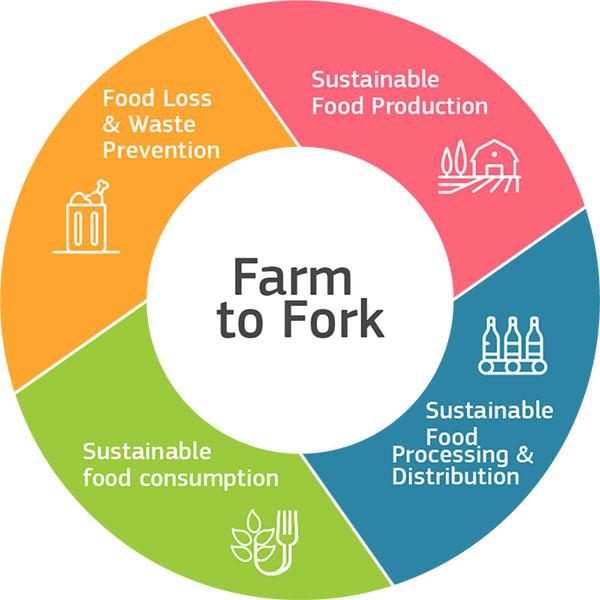
Farm to Fork (producer to consumer) strategy
The European Commission presented the “Producer to Consumer” strategy in May 2020 as one of the key actions of the European Green Deal. The strategy, which contributes to achieving climate neutrality by 2050, aims to ensure that the current EU food system becomes a sustainable model.
Its main objectives, among which the security of food supply and food safety are prioritised, are as follows:
- ensuring nutritious, sufficient and affordable food within the planet's limits;
- halving the use of pesticides and fertilisers and sales of antimicrobials;
- increase the area of land devoted to organic farming;
- promote more sustainable food consumption and healthy diets;
- reduce food losses and waste;
- combat food fraud in the supply chain;
- improve animal welfare.
Among the main initiatives under the “Producer-to-Consumer” strategy can be mentioned:
- Action Plan for Organic Farming which outlines a series of actions to enhance organic farming in the EU. Its main objective is to increase organic production to 25% of agricultural land dedicated to it by 2030;
- Plan for the security of food supply which, based on the vulnerability of the European food chain to serious supply problems encountered during the crisis triggered by Covid-19, contains measures to help the EU deal with challenges such as extreme weather events, plant and animal health issues and shortages of important inputs such as fertilisers, energy and labour;
- Global food safety standards, with a request for greater integration of sustainability considerations in the work of the Codex Alimentarius Commission;
- Carbon sequestration in agricultural soils.
Biodiversity Strategy
Another key element of the European Green Deal, alongside the Farm to Fork strategy, is the EU Biodiversity Strategy 2030, presented by the European Commission in May 2020, with the objective of intensifying efforts to counter the direct and indirect causes of biodiversity and natural resource loss.
In this context, the nature restoration regulation, which aims to restore biodiversity and ecosystems, in line with the objectives of the EU Biodiversity Strategy 2030.
The regulation aims to define recovery measures concerning at least 20% of land areas and 20% of marine areas in the EU by 2030 and all ecosystems in need of restoration by 2050.
The rules are the first ever to focus specifically on nature restoration in EU Member States and set binding EU-wide targets for restoration action with regard to
- degraded terrestrial and marine habitats;
- pollinators;
- agricultural ecosystems;
- urban areas;
- rivers and floodplains;
- forests.
EU efforts to halt the loss of biodiversity and ecosystems are also based on other important legislation: the Birds and Habitats Directives, the Water Framework Directive, and the Marine Strategy Framework Directive.
The Producer-to-Consumer Strategy and the EU Biodiversity Strategy, jointly presented by the Commission in 2020, share multiple objectives and targets, e.g. reducing the use of pesticides and fertilisers, restoring farmland and managing water resources.