
Agenda 2030 for Sustainable Development
The concept of sustainable development
According to the definition proposed in the report “Our Common Future, published in 1987 by the World Commission on Environment and Development (Bruntland Commission) of the United Nations Environment Programme, sustainable development means development that ensures «the satisfaction of the needs of the present generation without compromising the ability of future generations to realise their own needs».».
The concept of sustainability, in this sense, is linked to the compatibility between the development of economic activities and environmental protection. The possibility of ensuring the satisfaction of essential needs therefore implies the realisation of an economic development that has as its main purpose respect for the environment, but that at the same time also sees richer countries adopt production processes and lifestyles that are compatible with the biosphere's capacity to absorb the effects of human activities, and developing countries grow in demographic and economic terms at rates compatible with the ecosystem.
The concept of sustainable development is therefore elaborated by the Brundtland Commission on the basis of two fundamental elements: the environment as an essential dimension of economic development and intergenerational responsibility in the use of natural resources.
Beginning with the United Nations Conference on Environment and Development (UNCED) held in Rio de Janeiro in 1992, sustainable development thus understood found its official representation and consolidation in the acts adopted at the conclusion of the various multilateral meetings, but at the same time attention was extended to other dimensions of sustainability.
The Rio Acts and subsequent UN-sponsored world conferences, in particular the 2002 Johannesburg Conference, confirm a configuration of the principle of sustainable development based on three interdependent factors: environmental protection, economic growth and social development.
With the adoption in Gothenburg (Sweden) in 2001 of the EU Sustainable Development Strategy, a long-term plan for policy coordination for economically, socially and environmentally sustainable development, concrete measures are provided that affect all dimensions of development. The economic sustainability concerns the ability of an economic system to produce income and work on a lasting basis; the environmental sustainability concerns the protection of the ecosystem and the renewal of natural resources; the social sustainability is the ability to ensure that the conditions of human well-being are equally distributed.
The affirmation of the integrated vision of the three dimensions of development came in 2015, the year in which the UN's lengthy negotiation process on sustainable development, which led to the birth of the’Agenda 2030 for Sustainable Development, common commitment of countries to put the world on the path of sustainability.
The UN 2030 Agenda for Sustainable Development
The 2030 Agenda for Sustainable Development is a programme of action for people, planet and prosperity, signed on 25 September 2015 by 193 member countries of the United Nations, including Italy, to share a commitment to ensuring precisely a better present and future for the Earth and the peoples who inhabit it.
The Global Agenda defines 17 Sustainable Development Goals - SDGs) to be achieved by 2030, articulated in 169 Targets, which represent a compass to set Italy and the world on a sustainable path. The process of changing the development model is monitored through Goals, Targets and more than 240 indicators: against these parameters, each country is periodically assessed at the UN and by national and international public opinion.
The 2030 Agenda brings with it a major innovation: for the first time, a clear judgement is made on the unsustainability of the current development model, not only on an environmental level, but also on an economic and social one, thus definitively overcoming the idea that sustainability is only an environmental issue and affirming an integrated vision of the different dimensions of development.
The 2030 Agenda is based on five key concepts (the five “P's of sustainable development):
- People: combat poverty and social exclusion and promote health and well-being to ensure the conditions for human capital development;
- PlanetEnsuring sustainable management of natural resources, counteracting the loss of biodiversity and protecting environmental and cultural assets;
- Prosperity: affirming sustainable models of production and consumption, providing employment and quality training;
- PeacePromoting a non-violent and inclusive society, free of discrimination. Fighting lawlessness;
- Partnership: to intervene in the various areas in an integrated manner.
The SDGs are strongly interconnected. Since the three dimensions of development (economic, environmental and social) are closely interrelated, each Goal cannot be considered in isolation but must be pursued on the basis of a systemic approach that takes into account their interrelationships and does not have a negative impact on other spheres of development. Only the integrated growth of all three components will enable sustainable development to be achieved.
I 17 Goals refer to a set of important issues that take into account the three dimensions of sustainable development - economic, social and ecological - in a balanced manner, and aim to end poverty, fight inequality, tackle climate change and build peaceful societies that respect human rights.
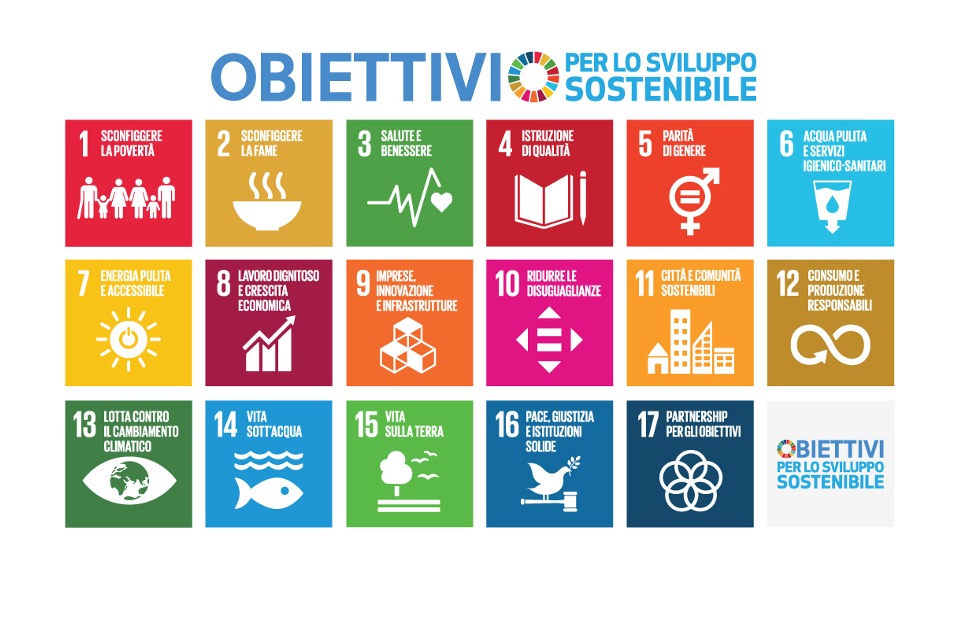
The goals set for sustainable development are global in scope, concern and involve all countries and components of society, from private companies to the public sector, from civil society to information and cultural workers.
The continuous evolution of the ethical-value system in modern society and its increasing perception by individuals have made sustainability, with its economic, social and environmental components, a crucial issue of our times.
In this context, there is a growing interest in protecting and adding value also to the intangible cultural heritage of countries and communities.
Geographical Indications, and the economic operators who guarantee their existence, can contribute to this goal.
Long before civil society and policy-makers questioned companies and brands about their impact on the well-being of employees and communities, as well as cultural and environmental preservation, GIs were sensitive to these issues.
When thinking about the fair distribution of value for all relevant actors in the value chain, GI products have worked well in remunerating primary producers, who are often penalised in the negotiation dynamics primarily with the retail sector.
Since GIs embody natural and human characteristics specific to their areas of origin and cannot be relocated, special care is taken to avoid soil degradation and biodiversity conservation.
Similarly, GIs have helped to preserve the traditions, the diversity of cultural identities of their territories around the world.
In recent years, there has been a systematic cataloguing of examples and good practices that demonstrate how Geographical Indications pursue an evolved concept of sustainability and, in this regard, research has also done its utmost to demonstrate, with a scientific method, the multiple benefits that the territories on which GI productions insist obtain in embracing increasingly ambitious sustainable development models.